
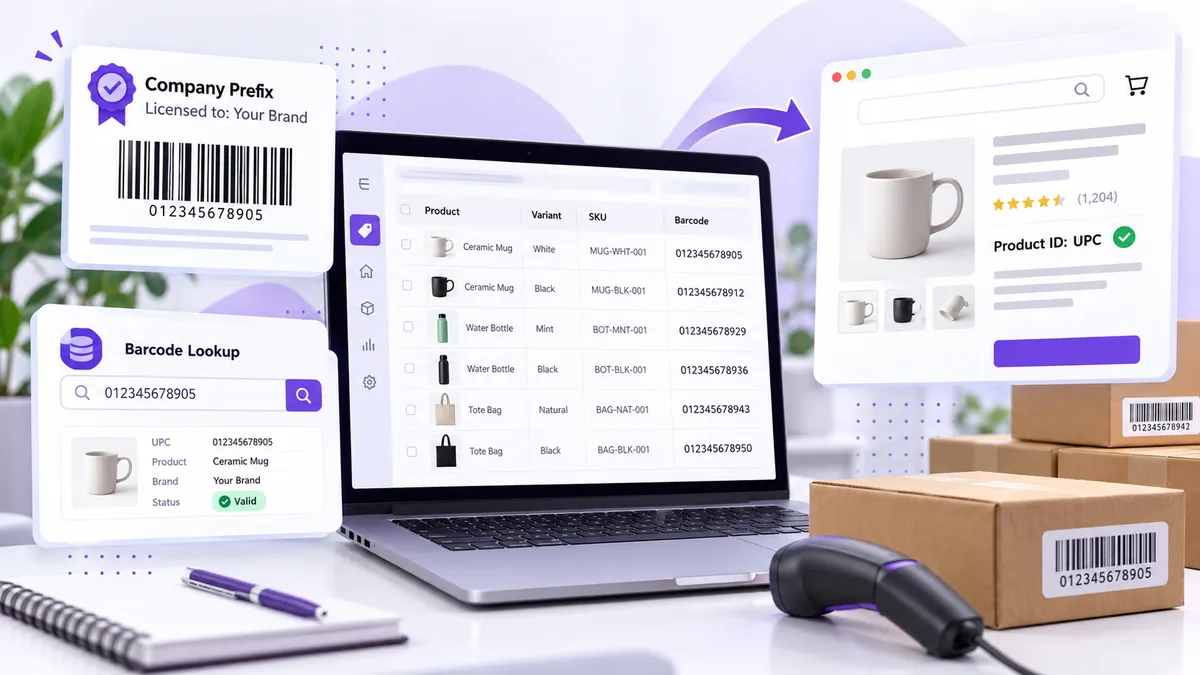
If you sell your own brand on both Shopify and Amazon, license your UPCs directly from GS1 so they’re registered to your company. Amazon checks UPCs against the GS1 database and treats codes that don’t match the GS1 record as invalid. GS1 US charges $30 per code (one-time) for a few products, or $250 plus $50 a year for a prefix covering 10. Put the same code in each variant’s Barcode field in Shopify and use it as the Product ID on Amazon. If you make or private-label products that have never had a barcode, you can apply for an Amazon GTIN exemption instead.
Cheap reseller codes, and any code that isn’t registered to your brand, are where Shopify merchants get burned on Amazon. Here’s why, and what to do instead.
Does Amazon require UPC codes?
For most categories, yes. Amazon’s listing rules say you must provide a unique product identifier, a GTIN (usually a UPC, EAN, ISBN or JAN), to create a new listing. Requirements vary by category, and some categories allow exemptions.
What matters is which kind of listing you’re creating:
- You’re selling someone else’s branded product (reselling, wholesale, arbitrage). The product already has a manufacturer UPC and almost certainly an existing Amazon listing. Use the manufacturer’s code and match the existing listing. Don’t buy new codes.
- You’re selling your own brand. You’re creating new listings, so you need GTINs that belong to you, or a GTIN exemption.
The rest of this guide is about the second case, the typical Shopify brand expanding to Amazon.
How does Amazon check whether a UPC is valid?
Amazon’s own words, from its Valid UPCs help page: “We verify the authenticity of product UPCs by checking the GS1 database. UPCs that do not match the information provided by GS1 will be considered invalid.” The same page tells sellers to get UPCs “directly from GS1 (and not from other third parties selling UPC licenses).”
The penalty isn’t only a rejected listing. Amazon says invalid UPC listings will be removed and “may result in your ASIN creation or selling privileges being temporarily or permanently removed.”
When a code fails the check, sellers typically see Error 8572: “You are using UPCs, EANs, ISBNs, ASINs, or JAN codes that do not match the products you are trying to list.” To appeal it, Amazon asks for a GS1-issued certificate showing your legal entity and the GTIN prefix, plus proof linking that entity to your brand. Its help page adds: “We do not accept that the barcode which is from a third party.”
In plain terms, Amazon looks up who the code belongs to in GS1’s database. If that company isn’t you (or the brand on your listing), the code fails.
Will reseller UPC codes work on Amazon?
Usually not for new listings under your own brand. Reseller codes are real numbers, but they were licensed to another company’s GS1 prefix, often years ago. When Amazon looks them up, the GS1 record names that company, not yours.
The same applies to any code that’s unique and GS1-originated but not brand-registered, including the codes sold in our own app. We say so on our listing (“these GTINs are not brand-registered”), and we’ll say it here: if you’re creating new Amazon listings for your own brand, don’t rely on codes that aren’t registered to you. We have a one-star review from a merchant who learned this the hard way, and we’d rather you didn’t.
Non-brand-registered codes still have legitimate uses: Google Shopping, your Shopify store, internal inventory and channels that don’t check GS1 ownership. They’re just the wrong tool for Amazon brand listings.
What’s the cheapest legitimate way to get UPCs for Amazon?
GS1, sized to your variant count. GS1 US pricing as of October 2026:
| What you need | GS1 option | Cost |
|---|---|---|
| 1–8 codes | Individual GS1 US GTINs | $30 each, one-time, no renewal |
| Up to 10 codes | Company prefix (10) | $250 initial + $50/year |
| Up to 100 codes | Company prefix (100) | $750 initial + $150/year |
| Up to 1,000 codes | Company prefix (1,000) | $2,500 initial + $500/year |
Count variants, not products. A candle in 4 scents and 2 sizes is 8 sellable items, so it needs 8 UPCs. GS1 says a single GTIN is licensed so that “your company is uniquely and exclusively identified as the owner of that number”, which is exactly what Amazon’s check looks for.
Up to 8 codes, singles cost less up front than a 10-code prefix ($240 vs. $250). At 9 or 10 codes the prefix is cheaper on day one, but singles come out even or ahead once you pay the prefix’s first $50 renewal. Past 10, you need a bigger prefix anyway, and it pays off fast if your catalog will grow. Keep the renewal in mind: GS1 says that if a prefix licence lapses, your company “will no longer appear in the GS1 Company Database, so customers won’t be able to verify your U.P.C.s”. Single GTINs don’t have that renewal risk.
Can you sell on Amazon without a UPC?
Yes, with a GTIN exemption, if you qualify. Amazon lets you apply for one if you sell:
- Private-label or handmade products
- Products you manufacture, brand or publish that have no barcodes
- Parts without a product ID (automotive parts, mobile accessories)
- Bundles you create (for example, a belt and wallet pack)
- Generic, unbranded products
You can’t get an exemption if the product already has a GS1 barcode or any existing GTIN, if the brand requires a UPC, or if the product is already in Amazon’s catalog. Amazon reviews real-world photos of every side of the product and packaging, and the brand name must be permanently on the product (printed, embossed, sewn-in label or permanent tag, not a removable sticker).
An exemption is a good fit for handmade and small-batch makers selling only on Amazon and their own store. If you plan to sell to retailers or other marketplaces later, you’ll need real GTINs anyway, so buying them up front can be simpler.
Is Amazon Brand Registry the same as a GTIN exemption?
No, and they get mixed up a lot. Brand Registry is Amazon’s brand-protection programme: it gives a trademark owner more control over listings that use their brand name. A GTIN exemption is what lets you list a product without a barcode. They’re separate applications, and being enrolled in Brand Registry doesn’t by itself remove the need for a GTIN or an exemption. If you own a trademark, enrolling is worth doing, but treat barcodes as a separate decision.
How do you set up UPCs across Shopify and Amazon, step by step?
- List every sellable variant across your catalog, including the ones you plan to add in the next year.
- License codes from GS1: singles for a handful of variants, or a prefix if you need more.
- Complete each GTIN’s product record with GS1. In GS1 US’s Data Hub, enter the brand name and product description for each code, using the same brand name you’ll use on Amazon.
- Assign one code per variant in Shopify. Each variant’s Barcode field holds its GTIN. For a big catalog, import your GS1 codes into a barcode app and auto-assign them instead of typing each one. Our guide to assigning and managing UPC barcodes covers both methods.
- Check for duplicates before you list. One code on two variants will cause a listing mismatch on Amazon and an “Incorrect GTIN” error on Google. Here’s how to find duplicate barcodes on Shopify.
- Use the same code as the Product ID on Amazon. If you push listings from Shopify through a connector app, confirm that its Product ID field reads the variant Barcode, not the SKU.
- Keep the brand name identical everywhere: GS1 record, Amazon listing and product packaging. A mismatch is the most common way a valid GS1 code still fails.
Where does a Shopify barcode app fit in?
An app doesn’t change Amazon’s rule. The code itself has to be registered to you. What an app does well is the busywork on the Shopify side.
Dragon Buy GTIN, UPC Barcodes lets you buy GS1-originated UPC/EAN/GTIN codes inside Shopify and auto-assign them to products and variants. You can also import codes you’ve licensed from GS1 and assign those. For an Amazon-focused brand, a sensible split is:
- Amazon listings: GS1 codes registered to your company, imported and assigned in the app.
- Products you’ll only sell on Shopify and Google Shopping: in-app codes are fine there and much cheaper (10 free, then 25 for $19 or 100 for $39).
If you’re not sure which channels a product will end up on, use GS1 codes for it. Changing a product’s GTIN after it’s listed is a bigger hassle than paying for the right code up front.
FAQ
Does Amazon provide UPC codes?
No. Amazon tells sellers to license UPCs from GS1. If your product has no barcode and qualifies, you can apply for a GTIN exemption instead.
Can I get UPC codes for Amazon for free?
Not legitimate ones. Free UPCs are recycled or unregistered numbers and will fail Amazon’s GS1 check. The only no-cost route is a GTIN exemption, and only if your product qualifies.
Can I use the same UPC on Shopify and Amazon?
Yes, and you should. A GTIN identifies the product, not the sales channel, so the same variant should carry the same code everywhere you sell it.
Do I need new UPCs if I resell another brand’s products?
No. Use the manufacturer’s existing UPC and match the existing Amazon listing. Amazon’s Error 8572 guidance says plainly that “using incorrect codes is prohibited”, and a new code on someone else’s branded product is an incorrect code.
What is Amazon Error 8572?
It means the product ID you entered doesn’t match the brand or product in GS1’s records. To fix it, either use a code registered to your brand, or appeal with a GS1 certificate showing your company and prefix plus proof that you own the brand.
I already bought reseller codes and Amazon rejected them. What now?
Use those codes on channels that don’t check GS1 ownership (your Shopify store, internal inventory), and license GS1 codes for the Amazon versions of those products. If the products are handmade or private label with no existing barcode, a GTIN exemption may be an alternative.
The bottom line
Amazon doesn’t care where you bought a UPC. It cares who GS1 says owns it. For your own brand, that has to be you: license GS1 codes ($30 each for a handful, a prefix for more), keep the brand name identical across GS1, Amazon and your packaging, and put the same code on each Shopify variant. Use an exemption if you’re a maker with unbarcoded products. Save cheaper, non-brand-registered codes for the channels that accept them.
Related reading
- Where to Buy UPC Codes for Shopify (Without Getting Burned): the full overview of GS1, resellers and in-app codes.
- GS1 vs. Resellers vs. Buying Codes In-App: The Cheapest Legit Option: what each option costs over three years.
- How to Fix “Missing GTIN” and “Invalid GTIN” Errors in Google Merchant Center: the Google side of the same codes.
Licensed your codes from GS1? Dragon Buy GTIN, UPC Barcodes can import them and auto-assign them to every variant, and it’s free to install. Questions about which codes you need? Contact us and we’ll give you a straight answer.