
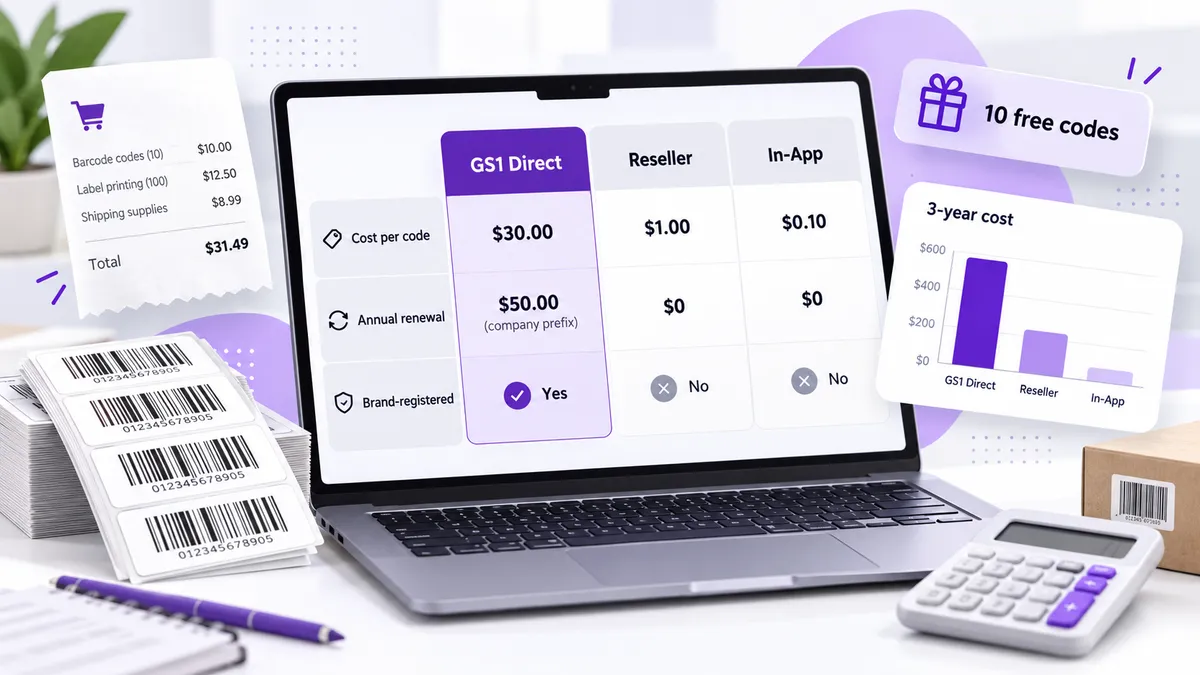
For a small Shopify store that sells only on its own site and Google Shopping, the cheapest legitimate option is usually GS1-originated codes bought in bulk, from a reseller or inside Shopify. They cost cents per code, with no renewals. If you sell your own brand on Amazon or to major retailers, GS1 is the cheapest option that actually works, because those channels check that the code is registered to you. With only a handful of products, GS1 US’s $30 single GTINs are often cheaper than people expect.
The right answer depends on two numbers: how many codes you need, and which channels check who owns them. Here’s the math.
Why are GS1 barcodes so expensive?
Because you’re not buying barcodes. You’re licensing a place in the global registry. A GS1 Company Prefix is a licence to a block of numbers registered to your company in the GS1 Company Database, which is what Amazon and big retailers check. GS1 US is a not-for-profit standards body, and the fee pays for the numbering system and that database listing. The annual renewal keeps you in it.
That’s also why the price feels high for a small catalog: you’re paying for registration infrastructure that a 10-product store mostly doesn’t use unless it sells somewhere that checks.
GS1 US pricing, from gs1us.org in October 2026:
| Codes | Initial fee | Annual renewal |
|---|---|---|
| 1 (single GS1 US GTIN) | $30 each | None |
| 10 (company prefix) | $250 | $50 |
| 100 | $750 | $150 |
| 1,000 | $2,500 | $500 |
| 10,000 | $6,500 | $1,300 |
These are GS1 US prices. GS1 offices in other countries set their own fees, often based on company turnover, so check your local GS1 if you’re outside the US.
What does “legit” actually mean for a UPC code?
A barcode can be fine on one channel and rejected on another. Three levels:
- Valid and unique. A real GS1-originated number with a correct check digit, assigned to only one product. That’s enough for Google Shopping, your Shopify store, POS and inventory. Google checks format, check digit, restricted ranges and duplicates. It doesn’t publish an ownership check the way Amazon does.
- Registered to your company. The GS1 database lists you as the owner. That’s what Amazon requires for new brand listings (“UPCs that do not match the information provided by GS1 will be considered invalid”) and what big-box retailers typically require.
- Not legit anywhere that matters. Made-up numbers, “free” codes and numbers sold to more than one buyer. Fine for a back-room label, a liability anywhere customer-facing.
Reseller codes and in-app codes are both level 1. GS1-direct codes (prefix or singles) are level 2. Be clear about which level you need before you compare prices.
What do UPC codes cost over three years?
Three-year totals (initial fee plus two renewals where they apply), at common small-store catalog sizes:
| Codes needed | GS1 singles ($30 each) | GS1 prefix (3 years) | Reseller (typical) | In-app (Dragon Buy GTIN, UPC Barcodes) |
|---|---|---|---|---|
| 5 | $150 | $350 (10-code prefix) | ~$5–$20 | $0 (10 free) |
| 25 | $750 | $1,050 (100-code prefix) | ~$15–$45 | $19 |
| 100 | $3,000 | $1,050 | ~$50–$80 | $39 |
| 1,000 | $30,000 | $3,500 | ~$300+ | $149 |
| Brand-registered to you? | Yes | Yes | No | No |
| Renewal? | No | Yes, or the codes lapse | No | No |
Reseller ranges come from public price lists we checked in October 2026: roughly $5–$12 for a single code, and around $80 for 100 or $320 for 1,000 at one larger reseller. Prices vary a lot between sellers.
What the table shows:
- Among GS1 options, singles beat the 10-code prefix for up to 10 codes over three years ($300 vs. $350 at 10), with no renewal to forget.
- Past about 25 codes, the prefix beats singles by a wide margin.
- Among level-1 options, in-app pricing is at or below typical reseller pricing, and the codes land directly on your Shopify variants instead of in a spreadsheet.
When is buying from GS1 directly the right call?
Pay GS1 when any of these is true:
- You’ll create Amazon listings for your own brand. Amazon checks the GS1 database and asks for a GS1 certificate in your company’s name when a code is challenged. Level-1 codes fail that check. Our guide to UPC codes for Shopify products you also sell on Amazon covers the details.
- You’re pitching retailers, distributors or grocery. GS1-registered codes are the standard expectation, and retailers commonly verify them against GS1 data.
- You only need a few codes for a strict channel. Five $30 singles ($150) are the cheapest legitimate way onto Amazon with five variants, and they never renew.
- You’re building a long-term brand. Codes registered to your company stay verifiable as long as the licence is current. Relabelling products later is more expensive than getting it right now.
One GS1 trap to know: if you let a prefix licence lapse, GS1 says your company “will no longer appear in the GS1 Company Database, so customers won’t be able to verify your U.P.C.s.” Budget for the renewal, or use singles if your catalog is small and stable.
When are resellers or in-app codes the smarter buy?
When none of the above applies. Typical cases:
- You sell only on your Shopify store and Google Shopping.
- You have many variants (apparel sizes and colours add up fast) and GS1’s per-code cost doesn’t make sense yet.
- You’re testing products before committing to a brand-wide GS1 setup.
- You need GTINs to clear Google Merchant Center errors on your own-brand products. Google doesn’t require GTINs for store-brand products (brand + MPN is accepted), but many merchants want them for consistency. See fixing missing GTIN errors in Google Merchant Center.
If you go this route, the difference between a reseller site and buying in-app is workflow more than legitimacy. Dragon Buy GTIN, UPC Barcodes is our app: you buy GS1-originated UPC/EAN/GTIN codes inside Shopify and auto-assign them to products and variants. Every code comes with a certificate of authenticity and never expires. Pricing is 10 codes free, then 25 for $19, 100 for $39, 1,000 for $149 or 10,000 for $899, all one-time. The honest limitation is the same as any reseller’s: the codes are not registered to your brand, so they’re not for Amazon brand listings or GS1-checking retailers.
With a reseller you get a list of numbers, paste them into a CSV, import it and hope nothing gets mangled. Buying in-app skips that step. Either way, check your catalog for duplicates afterwards. Our guide to finding duplicate barcodes on Shopify shows how.
Can you mix GS1 and cheaper codes in one store?
Yes, and for many small brands it’s the cheapest sensible setup:
- GS1 codes for the products you list on Amazon or sell wholesale
- In-app or reseller codes for products that live only on Shopify and Google Shopping
The rule that keeps this safe: one code per variant, never changed once the product is listed. If a Shopify-only product later moves to Amazon, give the Amazon version a GS1 code from the start rather than trying to reuse the cheap one.
How many codes do you actually need?
One per sellable variant. A product in 3 colours and 4 sizes needs 12 codes, not 1. Before you buy:
- Export your products from Shopify. The export has one row per variant.
- Count the variants that need a code now.
- Add the variants you expect to launch in the next 12 months.
- Buy to that number. At GS1, round up to the next tier. For in-app or reseller codes, buy the pack that covers it.
The where to buy UPC codes for Shopify guide has more on sizing and the trade-offs between sources.
FAQ
What is the cheapest legitimate alternative to GS1?
For Shopify and Google Shopping, GS1-originated codes bought in bulk, from a reputable reseller or in-app, at cents per code. For Amazon brand listings there’s no cheaper alternative that works: you need GS1 codes registered to you (from $30 each) or a GTIN exemption.
Do GS1 barcodes expire?
Single GS1 US GTINs don’t. They’re a one-time $30 with no renewal. Codes from a GS1 Company Prefix depend on the annual renewal. If the licence lapses, the prefix is terminated and your codes can no longer be verified.
Are resold UPC codes legit?
They’re real numbers, but they were originally licensed to other companies’ GS1 prefixes, so they’re not registered to you. Amazon explicitly tells sellers to get UPCs from GS1 “and not from other third parties selling UPC licenses.” The practical test is acceptance: resold codes work on channels that check only validity and uniqueness, and fail on channels that check ownership.
Is a $30 GS1 single GTIN worth it for a tiny store?
If you have fewer than about 10 variants and plan to sell on Amazon or to retailers, yes. It’s the cheapest code registered to your company, with no renewal. If you’ll only sell on Shopify and Google, cheaper codes do the job.
Why are in-app codes cheaper than GS1?
They’re a different product. GS1 licenses numbers registered to your company and maintains that registration. In-app and reseller codes are GS1-originated numbers that aren’t registered to your brand. That’s fine for some channels and not others, and the price reflects it.
The bottom line
Don’t ask what the cheapest barcode is. Ask what the cheapest barcode is that your channels will accept. Shopify plus Google Shopping only: buy GS1-originated codes in bulk. In-app pricing starts free for 10 and $39 for 100, and assigns them for you. Amazon brand listings or retail: pay GS1. Use $30 singles if you have under 10 variants, and a prefix once you’re past about 25. Selling in both worlds: mix them, one code per variant, and keep the GS1 codes for the products that need them.
Related reading
- Where to Buy UPC Codes for Shopify (Without Getting Burned): the overview of every source.
- How to Get UPC Codes for Shopify Products You Also Sell on Amazon: Amazon’s GS1 check, exemptions and Brand Registry.
- How to Assign & Manage UPC Barcodes on Your Shopify Store: getting codes onto every variant.
Selling on Shopify and Google Shopping? Install Dragon Buy GTIN, UPC Barcodes and get your first 10 GS1-originated codes free, auto-assigned to your variants. Not sure which codes you need? Contact us and we’ll tell you honestly.