
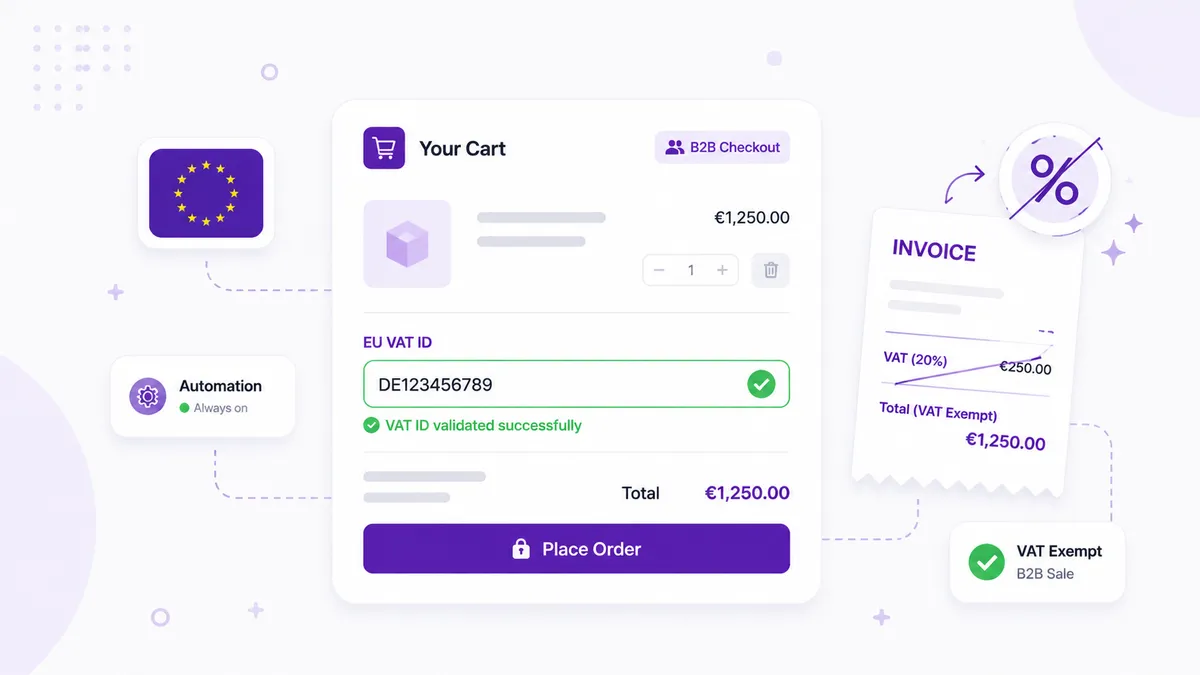
If you sell to businesses in the EU, you’ve run into VAT exemption: a VAT-registered company buys from you, and under EU reverse-charge rules you shouldn’t be charging them VAT. The problem is that Shopify doesn’t handle this out of the box — so most merchants end up doing it by hand. This guide explains how VAT exemption works on Shopify, why the manual approach quietly costs you time and money, and the best app to automate it.
How VAT exemption works on Shopify
In a standard EU sale, you charge VAT and remit it to your tax authority. For cross-border B2B sales between EU businesses, the reverse charge mechanism applies instead: you don’t charge VAT, and the buyer accounts for it on their own return.
A sale qualifies for exemption only when all of these are true:
- The buyer and seller are in different EU member states
- The buyer is a VAT-registered business, not a consumer
- The buyer’s VAT ID is valid and active in the official VIES database
- The purchase is for business use
If any condition fails — including a domestic (same-country) B2B sale — you charge VAT as normal.
The catch: Shopify has the building blocks but not the logic. It supports customer-level tax exemptions, metafields, and order notes, but it does not ship a VAT-number field, live VIES validation, or automatic exemption. So someone has to bridge that gap — either you, manually, or an app.
The manual workflow (and why it costs you)
Without an app, handling EU B2B usually looks like this:
- A customer emails asking to have VAT removed and sends their VAT ID
- You check the number by hand on the VIES website
- They place the order with VAT charged
- You manually refund the VAT portion afterward
- You add a note to the order and hope you remember the details at month-end
This breaks down in three expensive ways:
- It’s slow and manual. Every B2B order becomes an email thread plus a refund plus data entry — and it doesn’t scale as you grow.
- It leaks sales. Forcing business buyers to pay VAT up front and “get refunded later” is a clunky checkout experience that loses orders.
- It’s an audit risk. If you can’t prove each exempted order met all four conditions — VAT ID, VIES result, company name, country, tied to the specific order — the exemption is void and you owe the tax.
A particularly common mistake: validating a VAT number with a regex (format check) instead of VIES. A number can be perfectly formatted but inactive, dissolved, or fake. Only a live VIES lookup tells you whether it’s actually valid right now.
What the best VAT exemption app should do
Automating this properly means handling four things, in order:
- Capture the VAT ID before checkout — ideally on the cart — so the exemption applies up front instead of via a later refund.
- Validate against VIES in real time — a live call to the official service, not a regex or a cached list.
- Apply the exemption automatically — set the tax-exempt flag on the customer so checkout shows zero VAT with no manual step.
- Store the evidence — VAT ID, validation result, company name, and country saved durably (metafields/order notes) for audit.
The best app to automate Shopify VAT exemption
Our EU VAT Tax Exemption app is built to do exactly the four steps above, so the whole workflow runs without you touching it:
- Adds a customizable cart widget where the customer enters their email and VAT ID
- Validates in real time against the official VIES database across all 27 EU countries
- Creates a tax-exempt Shopify customer automatically, so checkout shows zero VAT — no refunds, no order edits
- Stores VAT details in customer metafields, with optional tags and order notes for invoicing and your records
- Supports 25 EU languages with fully customizable widget text
The customer enters their VAT ID once on the cart; if it validates, they check out tax-free — and you get a clean, audit-ready trail with zero manual work. There’s a 7-day free trial, so you can test it end-to-end with a real VAT ID before committing.
Is it worth automating?
If you’re already fielding B2B VAT requests by email, automation usually pays for itself within the first month — in time saved and in the orders you stop losing to a refund-after-the-fact checkout. If you only ever get the occasional B2B order, the manual route may be fine for now; the moment it becomes a recurring task, an app is the cheaper option.
Related reading
- How EU VAT Reverse Charge Works for Shopify B2B (and How to Automate It) — a deeper dive into the rules, the common mistakes, and what a good workflow looks like.
- How to Remove VAT for EU Customers with a VAT ID on Shopify — how to exempt VAT-registered EU business customers at checkout.
Ready to stop handling VAT exemptions by hand? Install the EU VAT Tax Exemption app — real-time VIES validation, automatic exemptions, and an audit-ready trail, with a 7-day free trial.