
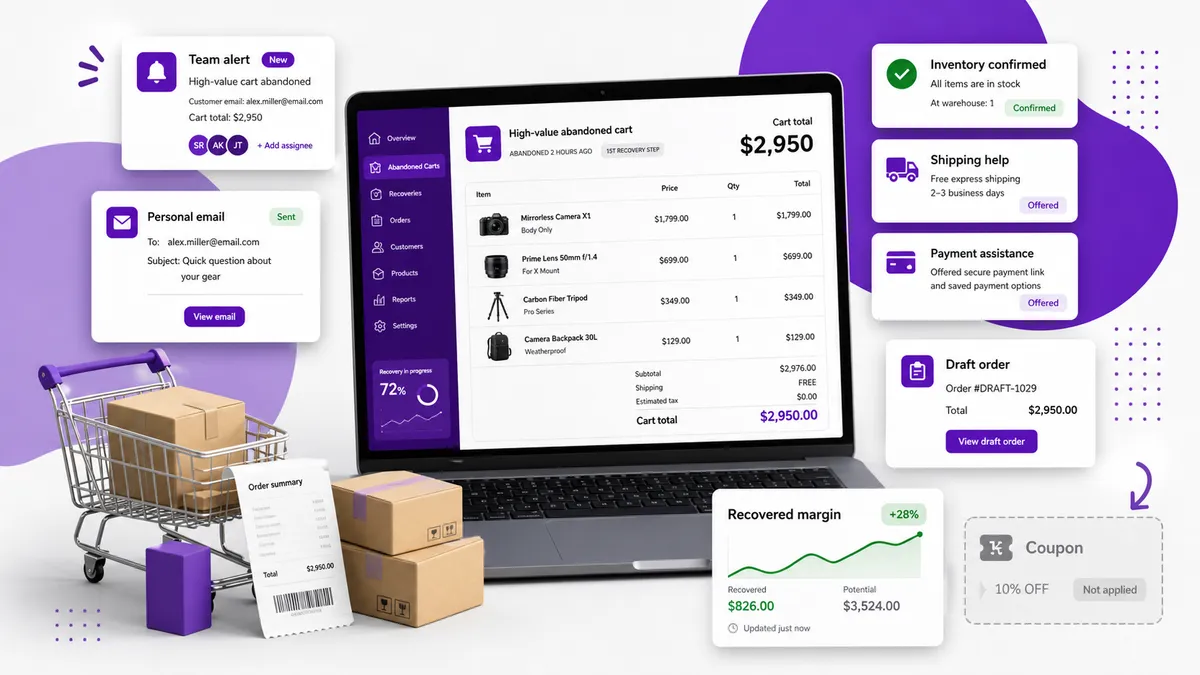
You can recover a high-value abandoned cart without a discount by responding quickly, identifying the specific point of friction, and making the purchase easier—not cheaper. For large carts, reassurance about inventory, delivery, payment, returns, or product fit can be more useful than a coupon.
The key is to reserve personal follow-up for carts valuable enough to justify it. A $30 cart and a $3,000 cart should not automatically receive the same recovery treatment.
Why not lead with a discount?
A discount can work, but it has costs:
- It gives away margin before you know price caused the abandonment
- It trains repeat buyers to wait for a coupon
- It makes future full-price offers feel less credible
- It can turn a service problem into a pricing problem
- On a large cart, even a small percentage can be a substantial amount
If a $2,000 cart earns a 10% coupon, you spent $200 to solve a problem that might have been a failed card or unanswered delivery question.
Ask first. Discount second.
Step 1: Define which carts deserve human attention
Set a value threshold based on economics rather than a round number that merely feels large.
Consider:
- Your average order value
- Gross margin, not only revenue
- Staff time required for follow-up
- Typical delivery or support complexity
- Customer lifetime value
- Whether the products are normally considered purchases
A useful threshold is high enough that a successful recovery comfortably pays for the human effort. Review it by product category: a high-revenue, low-margin cart may deserve less intervention than a smaller high-margin one.
Cart Radar lets you set both the cart-value threshold and the inactivity window, then sends email and Slack alerts when a qualifying checkout is abandoned.
Step 2: Look for the friction before writing
Shopify defines an abandoned checkout as a checkout that remains incomplete after the customer has provided contact information and not completed payment. In Shopify Admin, review the checkout and any available payment events before contacting the buyer.
Look for clues:
- Did payment fail?
- Did shipping become unexpectedly expensive?
- Is an item unavailable or slow to deliver?
- Is the order going to a country with duties or restrictions?
- Does the basket contain several similar variants, suggesting uncertainty?
- Is it a B2B-size quantity that may require approval or an invoice?
The goal is not to surveil the shopper. It is to avoid sending a generic coupon when the store already shows a more useful explanation.
Step 3: Send a helpful first message
Keep it short and specific:
Hi Sam — I noticed you weren’t able to finish your order for the oak dining set. If shipping, availability, or payment caused trouble, reply here and I’ll help. I can also prepare the order for you so you don’t need to rebuild the cart.
That message works because it:
- Identifies the purchase without sounding accusatory
- Names common sources of friction
- Offers help without assuming price is the issue
- Gives one easy action: reply
Avoid false urgency, guilt, or pretending an automated message is a personal one.
Step 4: Offer solutions that preserve price
Confirm inventory and delivery
Large purchases often carry logistical anxiety. Confirm stock, dispatch timing, freight cost, delivery access, and what happens if an item arrives damaged.
Answer product-fit questions
Provide measurements, compatibility, materials, warranty, or a quick comparison between the variants in the cart.
Fix payment friction
If a card failed, offer a clean checkout link or explain the payment methods available. For B2B buyers, clarify whether an invoice, purchase order, or payment terms can be supported.
Create a draft order
Rebuild the buyer’s cart as a Shopify draft order, make any agreed shipping or pricing adjustments, and send the secure checkout link. Draft orders can contain products, custom prices, discounts, shipping, taxes, and customer information.
Cart Radar can create a draft order directly from the abandoned-cart details with the cart items included, reducing manual re-entry.
Add value instead of cutting price
Where it makes commercial sense, offer help that costs less than a blanket coupon: priority handling, a delivery check, product setup advice, or a small relevant add-on.
Do not promise services your operation cannot deliver. A fast, accurate answer beats a perk that creates a fulfillment problem later.
Step 5: Know when a discount is justified
Discounting is reasonable when price is the confirmed blocker and the recovered gross profit still makes the order worthwhile.
Before offering one, calculate:
recovered revenue − product cost − fulfillment cost − discount − staff cost
Use the smallest intervention that solves the stated problem. That might be discounted shipping instead of 10% off the entire basket, or a quantity price on one line rather than a cart-wide coupon.
For wholesale-size quantities, a formal quote may be more appropriate than an abandoned-cart promotion.
Step 6: Measure recovered margin, not only recovered revenue
A recovery dashboard showing $10,000 returned to checkout looks good, but revenue alone does not tell you whether the strategy was profitable.
Track:
- Number and value of qualifying alerts
- Number contacted
- Number recovered
- Recovered revenue
- Discounts and concessions given
- Estimated gross profit recovered
- Staff time spent
- Common friction reasons
Cart Radar tracks which alerted carts return and totals recovered revenue. Add discount and margin data to your own review so you can compare personal follow-up with automated coupon campaigns honestly.
A no-discount recovery playbook
- Alert only on carts above a justified threshold.
- Review the checkout and payment context.
- Contact the buyer while the purchase is still fresh.
- Ask what stopped them instead of guessing.
- Solve delivery, product, or payment friction first.
- Send a draft-order checkout link when rebuilding the cart helps.
- Discount only when price is confirmed and the margin still works.
- Measure recovered profit and repeat problems.
For the broader workflow, read how to recover high-value abandoned carts and how to route alerts to sales staff.
If your biggest checkouts are still buried among routine abandonments, install Cart Radar, choose a threshold, and give your team the chance to solve the real problem before reaching for a coupon.