
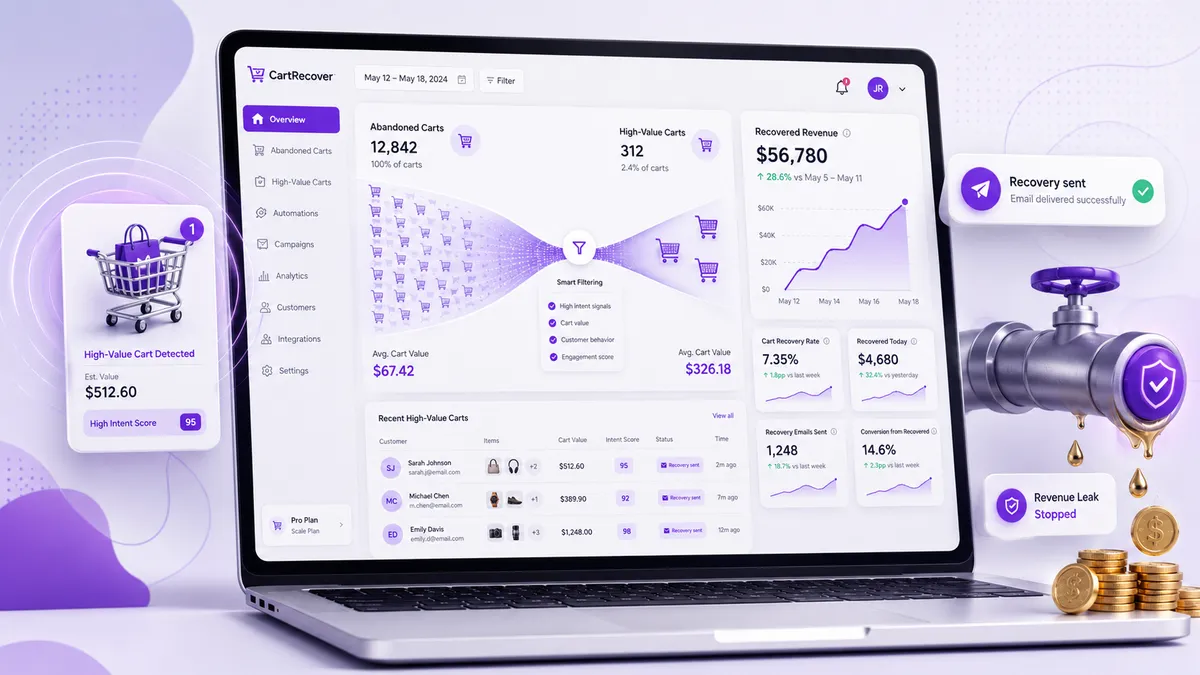
If you’ve ever looked at your Shopify analytics and thought “I’m losing way too much money to abandoned carts,” you’re not wrong — and you’re not alone. The average online store loses around 70% of its carts before checkout. Stare at that number long enough and it feels hopeless.
Here’s the reframe that changes everything: you’re not going to recover all of it, and you shouldn’t try. The path out of that sinking feeling isn’t chasing every abandoned cart — it’s getting ruthless about the ones actually worth recovering, and reaching those shoppers fast. Let’s build that plan.
First, Accept That Some Abandonment Is Normal
A lot of “abandoned carts” were never real sales. People add items to compare prices, save things for later, or window-shop with zero intent to buy today. No email, discount, or follow-up will convert them, because they were never going to purchase.
Trying to win back every cart is exhausting and pointless. It’s also why cart abandonment feels so overwhelming — you’re mentally counting losses that were never yours to begin with. Let those go. The money worth chasing is a much smaller, much more recoverable pile.
Then, Find the Money That’s Actually Recoverable
Not all abandoned carts are equal. Split them by value and a clear pattern emerges: a small slice of large carts usually accounts for a huge share of the lost revenue. Those are the ones where a timely nudge genuinely changes the outcome — because a shopper who filled a $500 cart wanted to buy. Something specific stopped them:
- An unexpected shipping or tax cost at the final step
- A payment that failed and never got retried
- Hesitation over a big purchase that a little reassurance would fix
- Plain distraction — they meant to come back
Every one of those is recoverable. But only if you know it happened while the intent is still warm — not from a report you read tomorrow.
The Plan: Stop the Bleeding Where It Actually Hurts
Instead of drowning in your overall abandonment rate, focus on a tight, high-leverage loop for your biggest carts. That’s exactly what Cart Radar is built for.
1. Set a value threshold
Decide what “worth chasing” means for your store and set it as a cart-value threshold. Now you only hear about carts big enough to matter — the noise disappears, and so does the overwhelm.
2. Get alerted the moment a big cart stalls
Cart Radar sends an instant email or Slack notification the second a qualifying cart goes idle. No waiting, no batch reports. You find out while the shopper might still be one message away from finishing.
3. Reach the shopper while it’s warm
From the alert, you can email the customer directly to answer whatever stopped them, or create a draft order with their items pre-loaded and send a one-click, ready-to-pay link. For a hesitant high-value buyer, that personal, immediate touch converts far better than any delayed automated email.
4. Watch the recovered revenue add up
Cart Radar tracks which alerted carts come back and totals the revenue you’ve recovered. That turns a vague, stressful “I’m losing so much” into a concrete number you’re actively clawing back — and it tells you exactly where to tune your threshold.
From Overwhelmed to In Control
The reason abandoned carts feel like a money pit is that you’re staring at one giant, undifferentiated loss. Break it apart and the picture calms down fast: most of it was never a sale, a slice of it is genuinely recoverable, and that slice is small enough to actually act on.
Focus there. Set a threshold, get real-time alerts on the carts worth your time, reach those shoppers fast, and measure what comes back. You’ll recover meaningful revenue and stop feeling like your store is leaking money everywhere.
Cart Radar’s free plan includes up to 5 alerts a month — enough to see real recovered revenue from your biggest carts. When you’re ready to catch every high-value cart, the Pro plan ($29/month, or $228/year) unlocks unlimited alerts.
Stop the bleeding where it counts. Install Cart Radar and start recovering the carts that actually matter.